Estimated reading time: 5 minutes
We’re often asked if cherry trees need thinning. So, as part of our continuing series about fruit thinning, in this blog, we’ll have a look at cherries.
We recommend that you thin all your deciduous fruit trees except for cherries.
Tell me about fruit thinning
In non-organic orchards, most thinning is done with chemicals. However, in your garden or backyard (where you want to be growing organically) you’ll be doing it by hand.
Cherry blossom is famously beautiful and inspires festivals around the world. Fruit tree flowers are all different, and all beautiful. The glorious spring display of flowers is one of the best parts of having a fruit tree in your garden.
But from a fruit-growing point of view, one of the most exciting parts of spring is actually at the end of the flowering period. It’s not always possible to tell how big your crop will be just from the number of flowers your tree has.
Watching the flowers dry up and fall off your trees reveals the tiny fruit underneath. After that, any fruit that isn’t fertilised will fall off (called “shedding out”). It’s only then that you can really start to assess how big (or small) your crop will be.

Why don’t cherries need thinning?
Remember the main reason we recommend thinning most fruit trees? It’s to prevent your trees from falling into the “on again, off again” pattern of cropping called biennial bearing.
Your cherry trees will usually have a pretty good crop most years. They are not nearly as likely to have a heavy crop one year followed by a light crop the year after. This is one of the many reasons we think cherry trees are the perfect backyard tree.

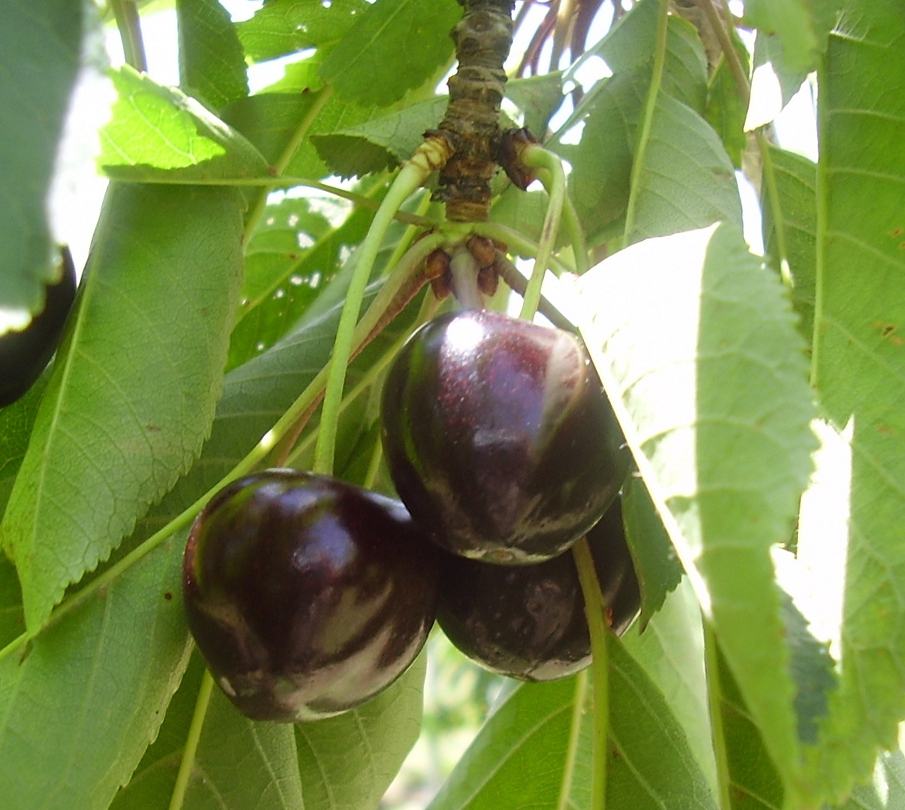
A beautiful crop of ripening cherries on Grow Great Fruit member Bozena’s tree
Cherries usually grow big enough without fruit thinning
Another reason for you to thin most fruit types is to give the fruit enough room to grow.
Again, this doesn’t really apply to cherries. Cherries grow on nice, long stems and don’t crowd each other out. If you remove some of the fruit by thinning, you might get a small advantage by letting the remaining fruit grow larger, but because cherries are small fruit anyway, the difference isn’t usually enough to be worth the time and effort.
You’re also unlikely to see branches or laterals in your cherry trees breaking under the weight of too much fruit. So that rules out the third reason you thin other fruit.
In fact, most of the reasons for you to thin other fruit just don’t apply to cherries, so that’s one job you don’t have to do!
Extra resources about growing cherry trees
Still keen to learn more about growing cherries? Excellent! It’s worth putting in the time to learning about these incredible fruit trees, because despite some challenges in growing them (like rain at the wrong time making the fruit split), the rewards are worth it.
🍒 Cheeky Cherries short course
🍒 How to Grow Amazing Cherries
🍒 How to get started with fruit thinning
🍒 Nine good reasons to grow cherries
🍒 Cherry pie and other delights
Related Articles

Are heritage nectarines worth the bother?
Heritage nectarines such as Goldmine are thin-skinned and can be hard to grow, but will reward you with amazing flavour.
5 tips for picking fruit at the right time
Picking fruit at the right stage of tree-ripeness is the key to eating fruit that tastes as good as your childhood memories.
Did you get the thinning right?
Assess how good your thinning efforts in spring were by checking the fruit quality and the health of your trees.

Hi there! Love your weekly tips. Wanted to let you know about my grafting experiment. I have a 5 year old Stella which put out lots of suckers one of which looked particularly healthy however last year fruited with tiny pip and skin cherries. I didn’t realise the original was a grafted tree! I decided to try my hand at grafting my other varieties onto the ‘feral’ tree and so did 2 each of stella, lappins and sunburst and all were successful. Two of the grafts have blossomed and are bearing a few fruit. Can hardly wait for them to ripen. Next season I’m planning to ‘rework’ the whole tree. regards.
Carol
Hi carol
I was under the impression that grafted trees were the ones to buy ????
Hi Carol – sounds like a great experiment, and very successful, so well done, it’s so satisfying getting a brand new tree for free. Congratulations.
You’re right Tony, unless you specifically buy a rootstock tree, then any tree you buy will be a grafted tree. Then if they put out a sucker (from below the tree), you get a rootstock tree for free (as long as the sucker has roots, of course!).
My mandarin tree produces a big crop of good flavoured fruit. The problems are 1. The skin doesn’t peel like a mandarin and have to be peeled with a knife and 2. the base of the fruit is thickened and the middle section is also thickened. The tree is very healthy , gets lots of organic feeding and plenty of water . Any ideas thank you .
Hi Tina, thanks for the question – have you seen our free citrus resource? Have a look at this page https://growgreatfruit.com/product-category/citrus/
Rats eat all my cherries before I get chance to pick any. They make holes in bird netting
Rats are a terrible pest Alison – unfortunately netting alone doesn’t work, you really need a more substantial barrier, i.e. a full enclosure with wire at least around the bottom of the enclosure.
no cherry crop for me this year on my beautiful lapin – every other year it’s steadily been yielding more and more (with netting), but this year, black aphid AND brown rot and I’ve discovered gummosis low down in the fork as well. it really feels out of whack,, and i’m wondering if the bushfire smoke and ash might have made for sappy growth. the good news is the zillions of ladybugs i’m rescuing from the netting before i soak it in water and vinegar. but apart from that, what do you recommend to help my tree feel balanced again?
Hi Hilary, thanks for getting in touch – sorry to hear about you being affected by the bushfire smoke last summer. It’s more likely the tree is responding to the mild wet spring we’ve had which has provided ideal conditions for most pests and diseases. If you still have any fruit on the trees, then a wettable sulphur spray will help prevent the brown rot from spreading any more. The best way to restore the resilience of the tree is stay away from nitrogen fertilisers (or any artificial fertiliser), keep it well-watered but not over-watered, give it some beautiful organic compost, and increase the biodiversity of the plants growing under/around the tree. Best of luck with it
Last year I got a lot of small (dime size) Lapin cherries on my tree. Are you saying the size of the cherries won’t increase if I thin the crop? Some years I’ve gotten larger cherries, so I know larger cherries are possible, but I’m not sure what influences the size. Thanks.
Hi Sandy, no the size of the cherries probably WILL increase if you thin the crop as we mention in the article, but the size differential is not likely to be that big, and so in most situations, people decide it’s not worth the effort. Cherry size is also determined by the nutritional status of the tree and how much water it gets, so they’re good things to pay attention to as well. If you’ve done all that and your cherries are still small then it might be worth giving it a try!
Can wettable sulphur be used for brown rot on apricot trees with set fruit?
I have a Lappins Cherry only planted last year. It looks very healthy with a few cherries on it this year but I’ve found a lot of curled up leaves with black (eggs maybe) and large ants are crawling around. I have pulled off curled leaves and disposed of them. What could this be and how can I treat it ?
Thanks
Hi, sounds like you might have a case of black aphids from your description. This blog post on aphids might help you be certain, plus it has some ideas of what to do! Good luck, Meg – Grow Great Fruit team.
I’m living in low chill area with Mediterranean feature. My young Stella and royal crimson cherry trees do not flower this year. Should I put ice around the trees as some experts suggest to encouraged flowering and fruits eventually? If so when is the best time? Many thanks in advance. Maria