Estimated reading time: 10 minutes
We sincerely hope and trust that you’ll never need to know how to help your fruit trees recover from fire.
Several of our Grow Great Fruit members are bushfire survivors, and the experience leaves deep scars, even after the fruit trees have recovered (if they survived the fire in the first place).
But if recent summers are anything to go by, fires are a growing risk, and it pays to be prepared.
Our experience with fires and fruit trees
We’ve had our own brushes with bushfires, so we want to share our experience. Hopefully, it will help you know what to do if you ever find yourself in this situation.
We’ve had experience with 3 fires since we’ve been farming, and each time we’ve learned more about fires and fruit trees.
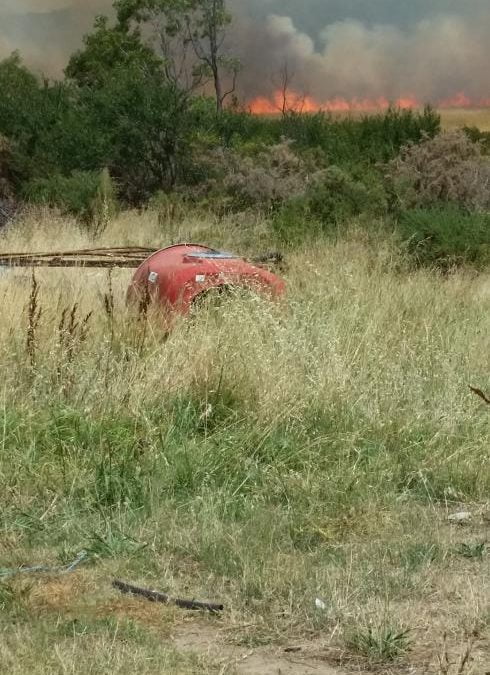
Our most recent experience was in January 2025, when a bushfire devastated our little central Victorian town of Harcourt, destroying 54 houses, many businesses, and dozens more gardens, sheds, and paddocks. The fire burned around three sides of our property and came to within 400m of us, but on that occasion, we were lucky.
Though we escaped damage ourselves, some family members, neighbours, and many in our community lost everything. For some people (including Katie’s sister, Liz), the fruit trees were the only things left standing.
In 2023, we had a mild scare when a bushfire came almost to our boundary, but luckily didn’t jump the road to our place. But in 2018, a bushfire raced through our orchard. This blog is about our first-hand experience of the devastation that fire left in its wake.

The 2018 bushfire in our orchard
The fire in 2018 was a traumatic experience to go through, but we were incredibly lucky. It gave us much more empathy for everyone who’s been through a bushfire and lost a house, livestock, or – so much worse – a loved one.
We got away very lightly.
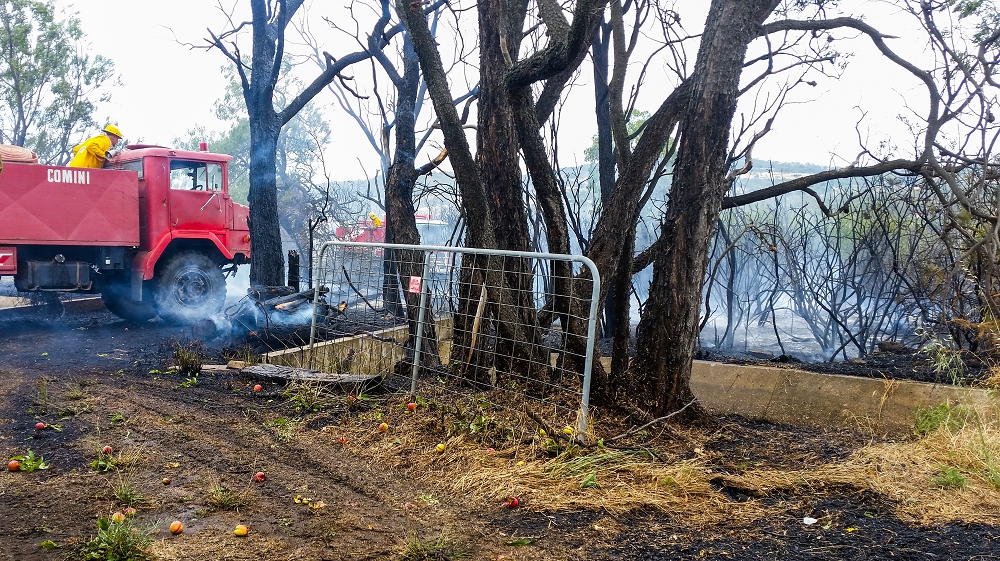
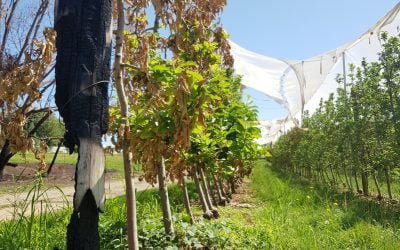
Our amazing fire services put the fire out promptly. In the end, we only lost about 300 fruit trees, some fences, and the irrigation system. The fruit trees were a mix of plum, peach, and nectarine trees.
Our most immediate concern after the fire (after having a good wash up and a cold bevy) was what to do next.
How can a bushfire damage fruit trees?
Here are some of the different types of damage that can occur to fruit trees in a fire:
- Leaves are scorched and die, but limbs survive
- Trees are burnt and die
- Trees are affected by radiant heat, killing the vascular system in the trunk and limbs
- Trunks are ringbarked by the vegetation burnt around the base of the tree
- Older trees can be damaged through embers lodging on the bark or in the crotch of the tree
- Root systems sometimes survive even though the tops have been killed
- Root systems are damaged by burning organic matter or heat in the rootzone
- Fruit is scorched or baked
- Irrigation lines and emitters are destroyed
- Defoliated trees can have limbs sunburnt after the fire
In our experience of fire and fruit trees, that list (which comes from Agriculture Victoria) is pretty much spot on!
We saw most of those outcomes in the 300 or so trees that were burned in our orchards.
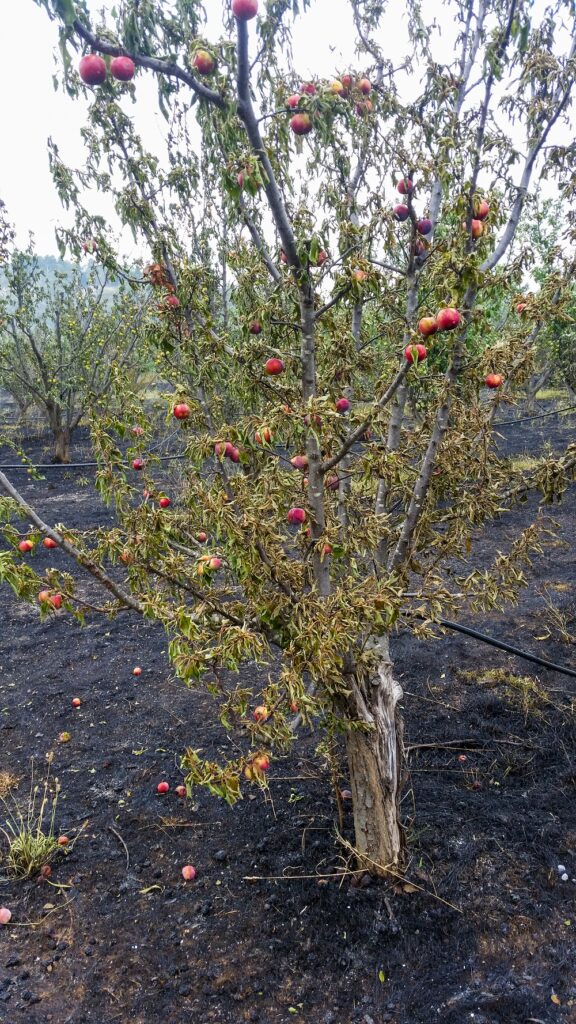
Immediate care for your fruit trees after a fire
The first thing you need to do after a fire is to assess your fruit trees as soon as possible. As hard as it is, try to decide whether they’re likely to live or die. If you’re not sure (and it can be very hard to tell), give them the benefit of the doubt in the early stages.
Here are our top 5 tips to help you take the next steps:
- Check the layer under the bark and see if it still looks healthy. This is one of the hardest things to assess, because very often the bark is burnt on part of the trunk, but not all the way around. In that case, wait and see how the tree responds. Check whether the bark is shrivelling, and in the week or two after the fire, look for signs of new shoots starting to emerge.
- Remove any remaining fruit to prevent pest and disease build-up and unwanted stress on the trees.
- If the irrigation system was damaged, re-establish it ASAP— if you think the trees are worth saving. If they’re not, then salvage anything re-usable from the irrigation system to re-use when you replant your trees.
- Delay pruning until regrowth has been established (possibly the following spring), so you can clearly see where there is new growth and dead wood.
- You may need to protect trees from sunburn if they’ve been completely defoliated. Use shade cloth or paint the trunk and branches with whitewash.
Asking for (and accepting) help after a fire
After our fire, we put out a call for help to the community to help us with removing fruit. There was a lot of fruit left on the trees, and some of it was still quite usable, but it wasn’t good enough for us to harvest and sell.
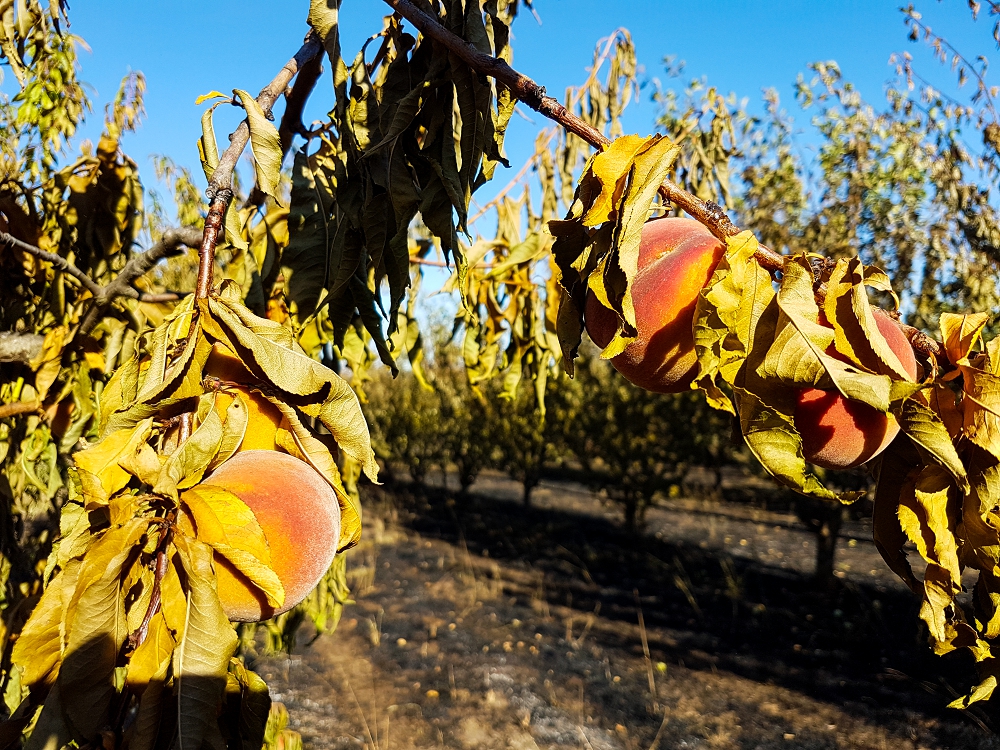
The job of removing all the burnt fruit was just too distressing and daunting to manage by ourselves.
In the typical response that communities tend to experience in disaster situations, we were overwhelmed with offers of help.
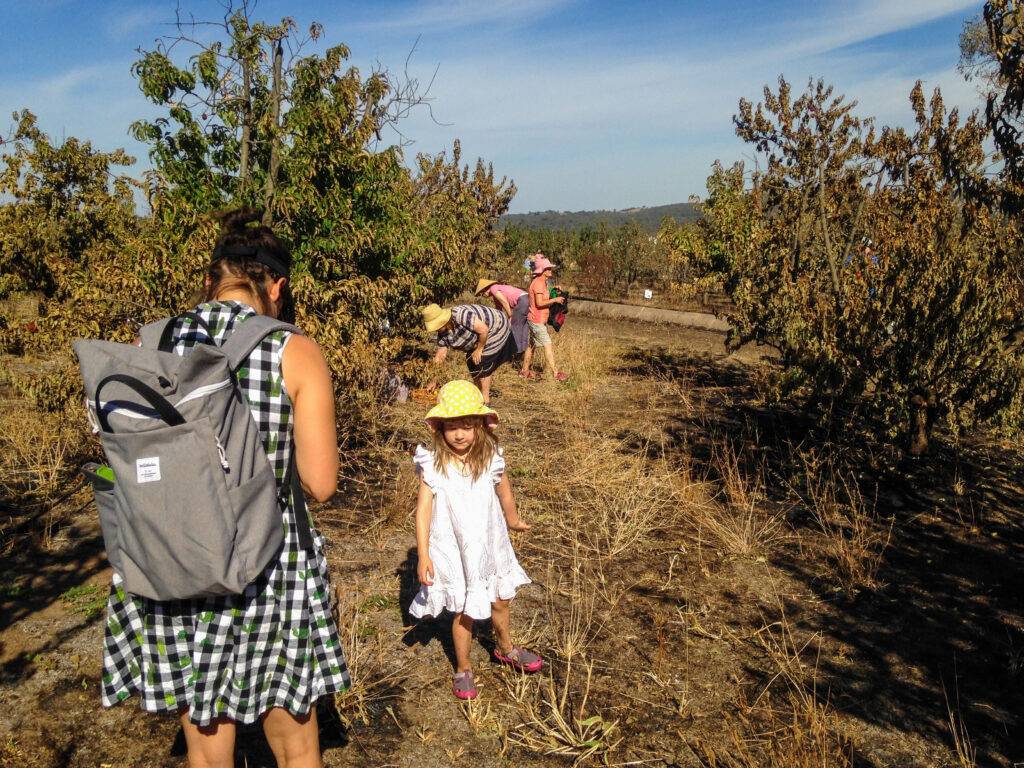
Within a week or so of the fire, we organised a clean-up day. The volunteers who came to help managed to clear all 300 trees in the day. They took home any fruit that was salvageable, and we also collected some generous donations for our local CFA.
Long-term recovery for fruit trees after a fire
Sadly, many trees just died after the fire. However, some survived, and a few trees that weren’t too badly damaged even started putting out new shoots within a few weeks.
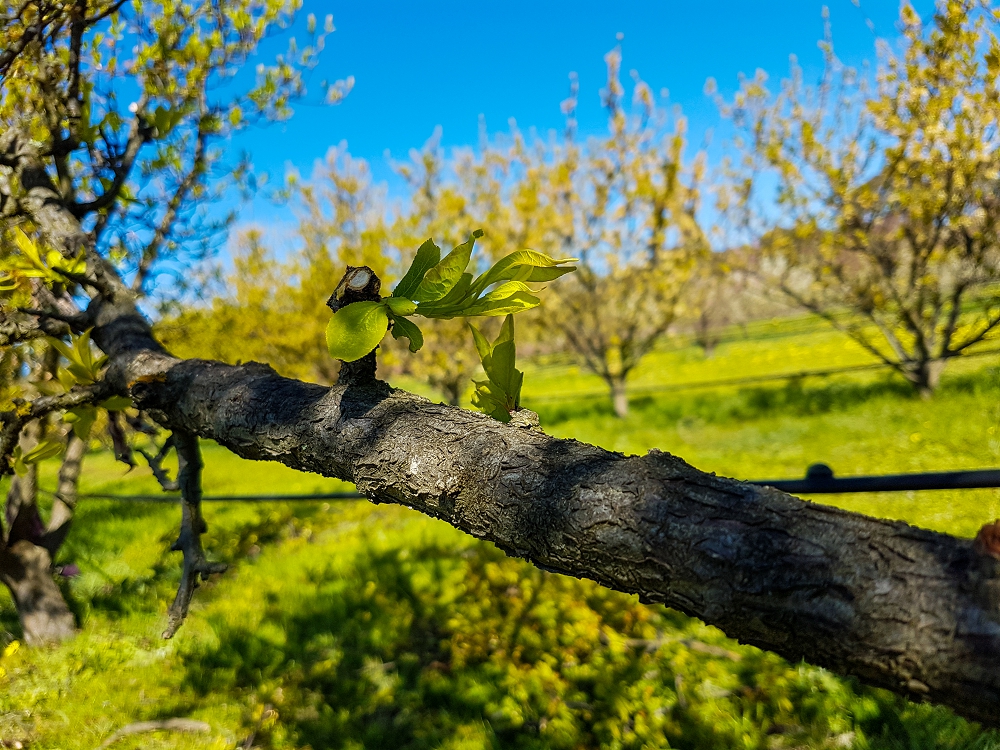
The following spring, some of the burnt trees flowered OK, even if they’d experienced quite a lot of damage to their wood.

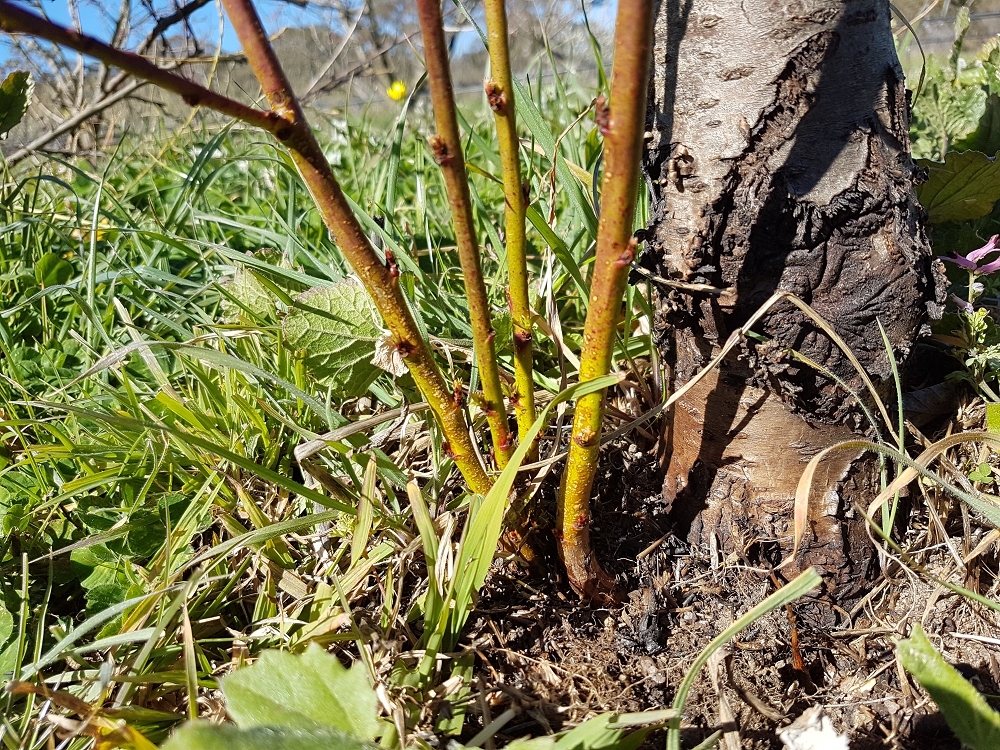
Other trees re-shot from the rootstock (if they were severely burned on top or ringbarked).
Lessons from the fire
So, what did we learn?
Our main “take-home” lesson was that if you’re going to remove a tree, do it sooner rather than later. Unless the tree is stone-cold dead, it’s likely to re-shoot, which may trick you into thinking it’s worth your time to try to nurse it back to health, even if it’s not.
One of the worst consequences was in trees that were badly burned around the base. If they survived, they usually re-shot at the tops of the branches. Some of them ended up with quite vigorous growth, but it was all high in the tree. The result was trees that grew much less fruit than before, and all the fruit grew high in the tree, making it harder to manage.
In retrospect, these trees should probably have been removed immediately.
As hard as it is to hear, the truth is that in many cases, if your tree has been badly burned, it’s probably better to cut your losses and start fresh with a new tree. It can take years for a burnt tree to recover completely, and even then, it may never function as well as before the fire.
Sharing our experience
Our other main lesson is that fruit trees are incredibly resilient!
We were able to save a few trees that had only been mildly burned. They re-shot so vigorously that it gave us plenty of opportunity to prune away the damaged wood and leave new shoots that grew into replacement limbs.
If you find yourself in this situation, please just follow the pruning principles in the Pruning Mature Fruit Trees course. The principles of removing fire-damaged wood from your trees are pretty much the same as removing disease-damaged wood.
We also learned that we’re pretty resilient. After the initial shock, we were able to get on with things really quickly, particularly because we received excellent support from the community.
We were also extremely fortunate that we received some compensation for our losses from the insurance company. That made a huge difference to our capacity to clear up trees and get on with our recovery.
We sincerely hope that you never have to go through a bushfire. But the reality of climate change is that summers are getting hotter and fires are getting worse.
If you do find yourself in this situation, we hope our experience will help you take the first steps to recovering your fruit trees.
Do you want to know more about natural disaster preparation and recovery?
Fires and other natural disasters are becoming more common and more extreme due to climate change. Fruit trees can be useful in creating a fire-protectant garden for your house, and we can also help with information about being prepared.
🔥 Preparing your fruit trees for fire season
🔥 The real impact of fire on fruit growing
🔥 Choosing the right fruit tree to plant
🔥 Drainage, flooding, & fruit trees
🔥 Introduction to Permaculture Masterclass
Related Articles
How old are fruit trees when you buy them from a nursery?
Wondering how old the trees you buy from a nursery are? We answer the question by explaining the process we use in our fruit tree nursery.
Can fruit trees survive a fire? (What we found out)
Natural disasters like fire and flood can have devastating impacts on farmers and home-fruit growers alike. Here’s one farmer’s story.

What home fruit growers can learn from farmers
Backyard growers can learn a lot about growing food from farmers’ experience and insights into the highs and lows.
Greetings! This is my first visit to your blog! We are a group of volunteers and starting a new initiative in a community in the same niche. Your blog provided us beneficial information to work on. You have done a marvellous job!|
i am from Nymboida NSW and got burnt out. Lost about half orchard. Mango and lemon and orange trees. The mangos are not showing any regrowth. Should I cut them down? Some mangos are showing some regrowth at the top, are they worth keeping? is there any way to get them to resprout lower down?
Hi James, sorry to hear about your fire experience and the loss of your orchard trees – so devastating. Please get in touch (through the contact us page) as we’re offering free Grow Great Fruit memberships to people who have been burnt out. Re whether or not to cut down the trees – if they’re dead, then yes you may as well cut your losses and pull them out. With the mangoes that are just re-shooting at the top (where it’s no use), you can try leaving one “nurse limb” in place and cutting the rest of the tree right back to knee height (or whatever is appropriate given your training system) to see if it will grow and you can re-establish a useful tree. How much work you’re prepared to put into the burnt trees depends on the health of the trees, your capacity to replant and various other factors.
Hi Marvel, so glad to hear the blog is useful for you and your group. Thanks for letting us know, and all the best with your fruit growing.
I found your blog today when deciding what to do with our orchard trees that just went through the CZU lightning fire, and appreciate the information. Thank you.
Hi Sea to Sky, so sorry to hear you’ve been through this experience – it can be devastating! Good luck with making your decisions regarding the trees, and with your recovery. All the best.
We had a fire on our property last November.
Our apple, peach, plum and cherry trees were burned.
The lilac and blackberry bushes came back beautifully.
The fruit trees have numerous suckers growing.
The plum has leaves growing towards the top.
Will any of the suckers on the peach and apple trees produce a viable stalk to regrow the tree or should we remove the stump?
Hi Lori,
Sorry to hear about the damage from fire at your place. Glad that some of the trees are recovering! Please get in touch (through the contact us page) as we’re offering free Grow Great Fruit memberships to people who have been burnt out. In the meantime, the most important thing to observe in your trees recovering is whether they are shooting above or below the graft. If it’s above, they might well be viable fruit bearing stems. If below, you probably want to consider grafting on your desired varieties to the root stock. In that case, you are still further ahead than planting new trees, and it might be an opportunity to really think about the varieties you want! Here’s a link to our blog on grafting that might help you get started. Thanks – Meg, Grow Great Fruit team.
My home and property burned to the ground in 2018 Woolsey fire in coastal Southern California. As we slowly rebuild I noticed the american persimmon tree roots have put out some vigorously growing suckers. They are 5 feet tall with an inch thick truck in some cases by now. Can these suckers grow back into a fruiting tree? Should I cut back all but one?
Thank you for your advice!
So sorry to hear about your fire experience Molly – some of our members down here in Aus could definitely empathise with that experience. Regarding your persimmon tree – was it a grafted tree? If it was, and you’re getting suckers below the graft, then you might want to think about regrafting. Otherwise, if it was a seedling stock in the first place, you can definitely allow one of the trunks to develop as a leader and into a fruiting tree. Persimmons can fruit from seedling trees, they can just take a bit longer to produce fruit than a grafted tree. Good luck, Meg – Grow Great Fruit team.
my small hobby orchard was scorched last week, the trunks don’t look burned but the super heated air dessicated the leaves, not sure what to do, i have restored the irrigation and will check the cambium layer and decide, they were young trees so this was the second year i allowed them to fruit, i am so bummed
Sorry to hear about your experience Connie – where are you? Please get in touch via the Contact Us page if you’d like to explore our free membership offer for people who have been burnt out. In the meantime, watering the trees is the best thing to do in the short term, if they haven’t been directly burnt there’s a good chance they’ll survive the experience.