Use our foolproof 7-step Pruning Method
Estimated reading time: 9 minutes
Are you confused about pruning your fruit trees?
You’re not alone. It’s one of the biggest worries for home fruit growers. Many are not sure when to prune, how to prune, or even which trees they should prune.
Related Articles
Taming monster fruit trees with renovation pruning
Learn how to use a technique called renovation pruning to tame large, unpruned, and out-of-control monster fruit trees.

How to plant a fruit tree – the easy way
Everything you need to know about how to plant your new fruit trees to get them off to a great start in life.
How to buy a good fruit tree
Learn how to select a healthy fruit tree when you’re buying from a nursery, to give your trees the best possible start in life.
How would you feel to learn that there’s no such thing as “right” or “wrong” when it comes to pruning, just cuts and consequences?
Relieved, right?
When it comes to teaching people how to prune, that’s our approach.
We find it instantly removes a lot of the stress about having to get pruning “right”, and replaces it with a curiosity about how a fruit tree responds when you prune in particular ways.
And that’s a great starting point for learning how to prune.
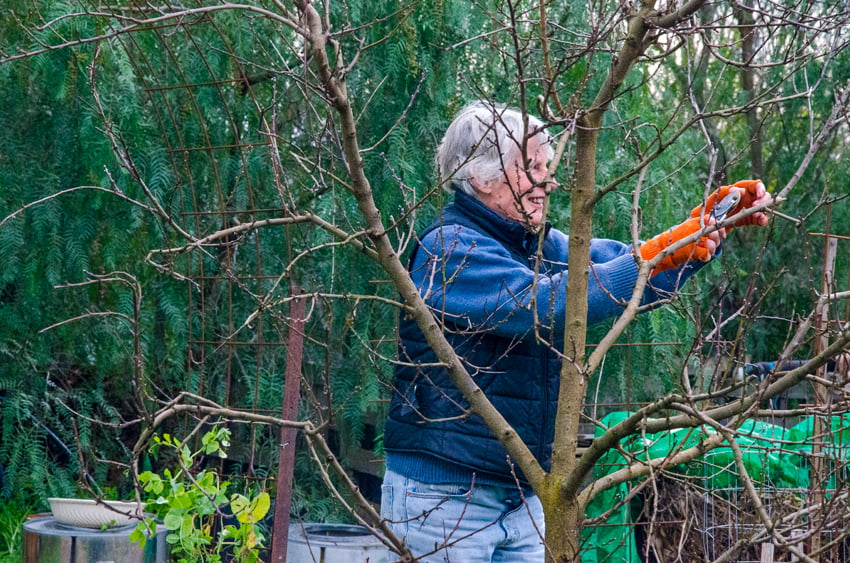
Why should you prune your fruit trees?
Pruning is not actually needed for a tree to bear fruit. In fact, the fastest way to get a new tree to bear fruit is not to prune it at all.
But while it’s tempting to get fruit from your trees as quickly as possible, not pruning is a bad idea for lots of reasons.
The first and most important reason to prune your trees is to establish a strong framework for the tree. This is particularly important for the first three or so years after you plant a fruit tree, and it’s a specialised area of pruning called “establishment pruning”.
From a practical point of view, pruning keeps the tree at the right height and shape for its location. You can also make sure the fruit will form on branches that you can easily reach. This makes thinning and picking much easier.
Overall, pruning improves the quality of your fruit.
We also recommend learning more about the different parts of your fruit tree and learning how to tell the difference between fruit buds and leaf buds.
It’s also a good idea to invest in a good pair of secateurs, such as Felcos (and no, we don’t get a kickback, we just like these secateurs. They also come in a left-handed version).
How pruning fruit trees can help keep them healthy
The first principle of pruning is to remove all the dead and diseased wood. This is one of the key hygiene practices that you should be following all the time with your fruit trees.
Removing the diseased wood helps to reduce the load of pathogens in the tree that will reinfect it the following year.
It’s also important to correctly dispose of any diseased wood that you remove from the tree.
Prunings are a resource, and full of organic matter and nutrients. Ideally, they should be returned to the soil. But if the wood is diseased it’s really important to “clean” it somehow first, rather than just leaving them lying on the ground under your fruit tree. This blog covers 3 different ways of managing your prunings.
Pruning helps improve air circulation in the tree, and that helps to prevent disease. It allows more sun to get into the tree, which keeps it healthy and more fruitful.
Are there reasons not to prune your fruit tree?
As we already mentioned, pruning your tree can delay fruiting in your tree. It can also reduce the yield of fruit, and create smaller trees.
These are often cited as reasons not to prune, but we actually think they’re all good things!
Harvesting a smaller crop of fruit that’s better quality is by far preferable to harvesting a large crop of small, poor quality fruit, or trying to harvest fruit from the top of a massive tree. And it’s much better for your tree.
How do trees respond to pruning?
Fruit trees are always in balance between the parts of the tree that are below the ground (i.e., the roots) and the parts of the tree above the ground (the trunk, branches etc.).
Pruning changes that balance. The tree responds by growing more shoots, until the balance is re-established.
Usually, the regrowth is stimulated near where the cuts were made. The more pruning cuts you make and the more wood you remove from the tree, the more you stimulate a more generalised response, where growth is stimulated across the whole tree.
Basically, more pruning = more regrowth.
Understanding the principles behind pruning fruit trees
Here at Grow Great Fruit HQ, we steer clear of pruning “rules”. Here are just some we’ve heard over the years:
“Always remove 1/3 of the branch”
“Don’t prune in summer”
“Prune after fruiting”
“Remove all side-shoots that are bigger than 1/3 the diameter of the main branch”
“Remove all shoots that are growing into the middle of the tree”
Confused, much?
The truth is that some of these “rules” apply to some trees, some of the time. (We would never suggest removing all the shoots that grow into the middle of the tree, and have seen many trees damaged as a result of this practice.)
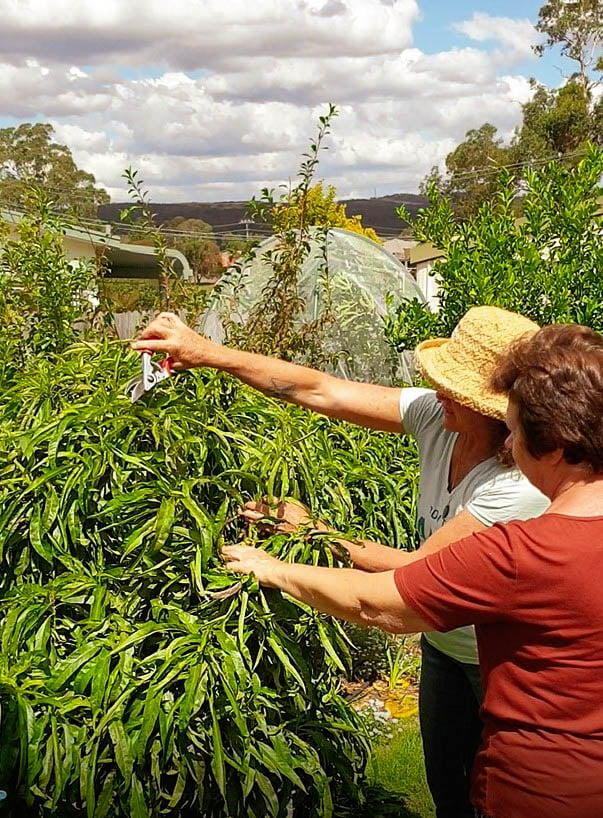
Fruit trees are all different, so we think it’s much safer and more effective to learn the principles behind pruning. Then you can apply these same principles to pretty much all fruit trees, all the time.
- Remove dead and diseased wood
- Prune as little as possible to maintain the right shape
- Prune in winter to encourage growth
- Trim your trees in summer to slow growth
- Heading cuts create branching
- Sap flows most strongly to the highest part of the tree
- Horizontal wood produces more fruit than vertical wood
- Encourage fruit to grow close to the trunk and main limbs
- Prune young trees when you plant them
- Remove suckers when pruning
The difference between heading cuts and thinning cuts
Heading cuts are any cuts that remove the end of a shoot or limb. The bud on the tip of any shoot is called the “apical” bud, and a heading cut removes this bud.
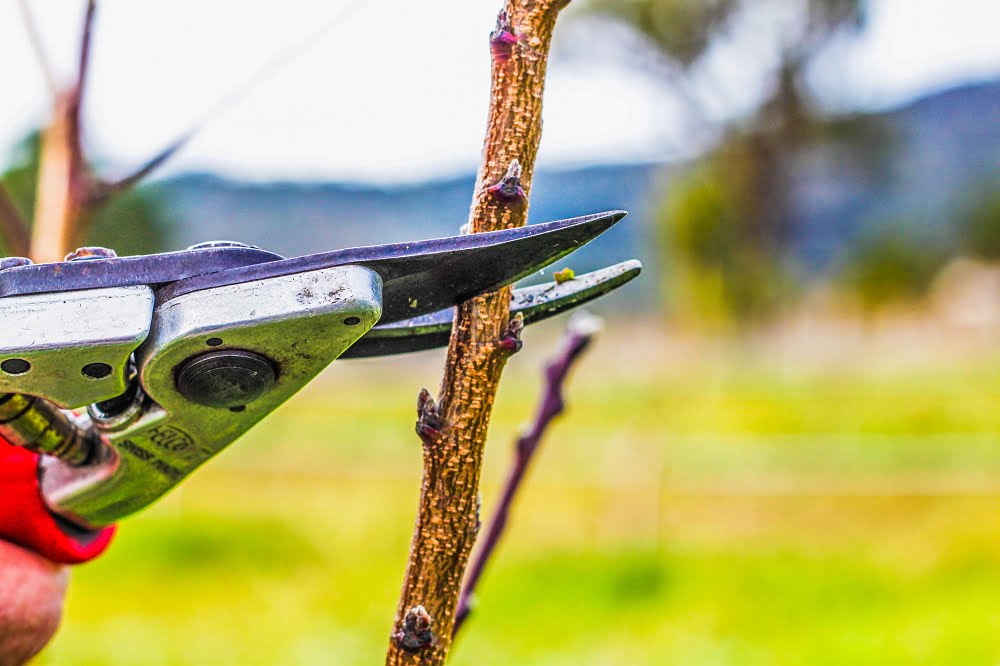
The job of the apical bud is to prevent the buds below it from growing into shoots.
As soon as you understand that, it’s pretty obvious what will happen next if you make a heading cut that removes this bud.
Yep, you’ll create branching.
That’s not good or bad, it’s just the likely consequence of this type of cut.
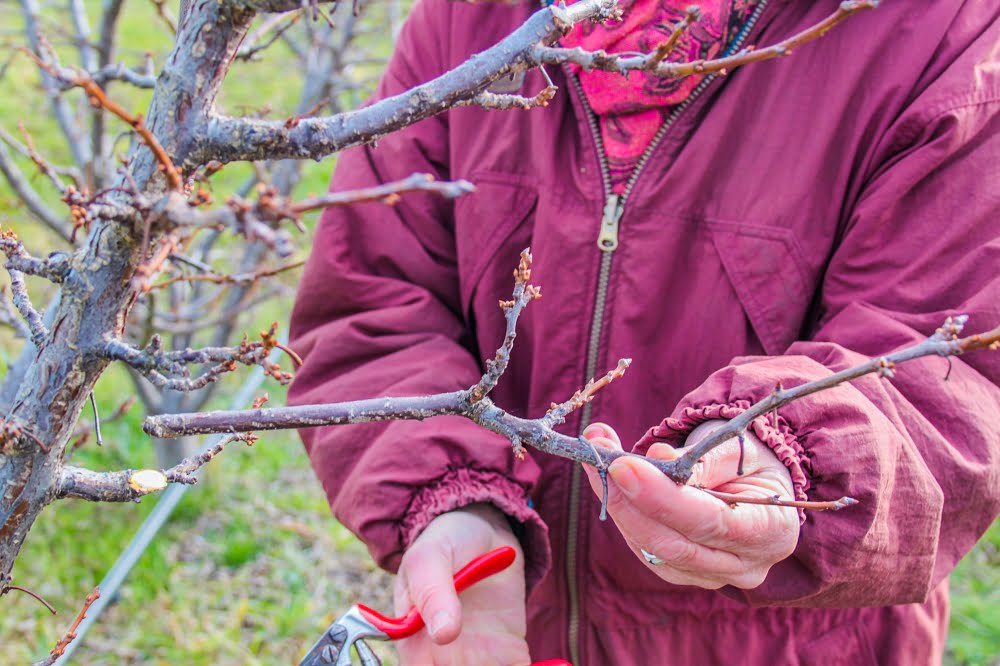
There are a couple of different types of thinning cuts. They can be used to remove entire shoots or branches or to cut back to a lateral shoot or spur. The point is to leave the apical bud intact at the end of the branch or shoot that you’re working on.
As you can immediately tell, thinning cuts are much calmer. It’s a great technique for removing wood from your fruit tree without stimulating lots of new growth.
This is powerful knowledge! Now you know how to create more branching in your fruit tree, and also how to prevent creating branching where you don’t want it.
The Grow Great Fruit foolproof 7-step pruning method
Now, we can bring all the information together into this very simple 7-step method.
- Remove dead or diseased wood.
- Look at the tree and imagine what shape you want it to be – if you’re not sure, the “vase” shape suits most backyards. There’s more information about different tree shapes including espalier in our Pruning by Numbers ebook.
- Identify the permanent limbs. Do any major limbs or branches need removing? If you’re not sure, leave them for now. The first time you prune your tree it may be difficult to identify the permanent limbs, but the more you apply this method year after year, the more obvious it becomes.
- Choose the easiest looking limb. Starting at the top of the limb, define and cut the leader to the right height. Use a thinning cut so you don’t create branching in the top of your tree. Aim to keep the top of your branches quite simple.
- Work your way very methodically down the limb. At each lateral (side shoot) growing from the branch, stop and make a decision about what to do with it. There are only three choices! Either leave it alone, shorten it, or remove it. Don’t remove a lateral if there are no others growing nearby, as this creates bare patches with no fruiting wood on the limb. (PRO TIP: don’t do the same thing to each lateral.)
- Do the next limb, and methodically work your way around the tree.
- To finish, remove any suckers that are growing from below the graft union.
And that’s it! If it sounds simple, that’s because it is. While you’re learning, it can be really helpful to take lots of photos of your tree. Take ‘before’ and ‘after’ shots, but more importantly, take photos of the same tree in spring and summer after you’ve pruned.
That’s where you really get to see the consequences of your cuts. And that’s where the gold is.
Related Articles
Taming monster fruit trees with renovation pruning
Learn how to use a technique called renovation pruning to tame large, unpruned, and out-of-control monster fruit trees.
How to plant a fruit tree – the easy way
Everything you need to know about how to plant your new fruit trees to get them off to a great start in life.
How to buy a good fruit tree
Learn how to select a healthy fruit tree when you’re buying from a nursery, to give your trees the best possible start in life.
Great info, thanks
What brand are the secateurs that you use?
Hi Wendy,
We use Felco secateurs. They are one of the best brands, and we always feel it’s worth investing in a quality pair, as all parts are replaceable and the high quality steel means you can get and keep a good sharp edge.
Thank you! I’m feeling a bit braver about pruning a poor grapefruit that I have – it’s been in the ground at one residence (and did poorly), dug up and transported in a pot in Autumn, and now in ground. It has started sprouting shoots off main trunk but has lots of dead wood at top.
Hopefully, what I do tomorrow helps it 🙏
That’s excellent Tess, good luck with the grapefruit – hopefully it will now thrive with your love and attention!
Great information, thank you. I would like to graft a plum, nectarine and peach tree.When can this be done?? I live in Melbourne.
Hi Miranda – great plan, we’re huge fans of learning how to graft your own trees. February is the best time of year to bud-graft fruit trees in Melbourne. It’s also the easiest and most reliable form of grafting – you can learn more about it here – https://growgreatfruit.com/product/grafting-technique-4-summer-grafting-budding/
If I am trying to keep my dwarf trees small do I prune the longer limbs in summer or winter
Hi Marg, pruning in late summer will help to reduce the growth response in the tree, so helps to keep the trees smaller. But, it’s much harder to see the structure of the trees in summer when they’re covered in leaves. Dwarf trees are fairly easy to keep small anyway because they’re on a dwarf rootstock. So for the first few years at least, while you’re getting familiar with your trees and learning how to prune them we’d recommend pruning in winter when you can easily see what you’re doing. If you need help with any specific trees take a photo of them and post it on the Members Forum, and we can help you decide how to prune it.
How do I get rid of Gumossis on my young apricot tree. It is low on the trunk of the tree.
Thanks
Hi Alison – you probably don’t! The gummosis could be caused by a few different things, including Phytophthora, bacterial canker, or physical damage – you can check out the differences in this course to try to identify the cause https://growgreatfruit.com/product/keep-your-fruit-trees-free-from-disease/. Trees can actually manage fine with some gummosis, the important things are whether they are still growing and looking happy and whether they continue to have fruit.
Awesome post, thanks for the recommendation also, I’ll learn and figure out this very simple 7-step method. I have also noticed, driving around my area near revere ma, there are many fruit trees in need of pruning, that’s great if i can make tree services here, i got experiences as a gardener, working this kinds of side-jobs more than 10 years. I have register a certificate and hope someone could give me a call soon
I have two dwarf pear trees that were only planted as bare root last year (July/Aug) and I pruned quite heavily after planting. Both seem to only have one main leader branch still, and haven’t really branched well at all. Should I prune heavily again in another attempt to get them to branch?
Hi Jen,
You are still in the establishment phase for setting the shape of how your trees will grow. In this phase, you can definitely do another purposeful heavy prune to achieve the shape you want and perhaps achieve better branching. You might find our pruning young fruit trees course useful in the meantime. Thanks – Meg, Grow Great Fruit team.
Thanks for the great info! I was wondering if you have a recommendation for a pruning saw for the larger branches?
Hello Jen,
Depending on the scale of your orchard, the size of your trees and your budget there are a few options.
Felco has a moderately priced folding pruning saw that is great for the home orchard.
Next price bracket is Opinel – they have a really lovely, light, nimble folding saw on the market and they are great quality steel blades.
Another brand to look out for is ‘Silky’ – they are a very well regarded Japanese saw brand on the pricier side, and have lots of different sizes (from pocket sized up to long handled). Beloved by arborists, the quality of the blades is amazingly good and many of them have replaceable parts. Some of the smaller Silky options are great for camping too! I have a small folding silky that is sooo lovely to use and well made and I definitely recommend them.
Either way, it’s worth spending for a good quality blade that will last a lot longer and be easier to keep sharp. Plus, we always prefer tools with replaceable/maintainable parts as you can often go on using them for years. Happy to talk pruning anytime :), good luck, Meg – Grow Great Fruit team.
For years my apricot tree has provided a lot of fruit which I (and the Noisy Minors!!) have enjoyed. This year though it only provided about 10 apricots while growing MUCH larger. It’s now about 4m tall and probably 20m in circumference. Should i give it a heavy prune and why do you think it didn’t fruit this year?
Hmm – there could be a few reasons Ben, and pruning could be one of them. It was also a really tricky year for apricots with the wet year causing blossom & twig blight, which lead to limited fruit-set. Did you notice any signs of disease? Have a look at our blog on things that can go wrong with Apricots and that might give you a few pointers to start with! Meg – GGF team.
I decided to summer prune this year because we were having consecutive days of dry weather. Now I am wondering if I did the right thing because where I made the cuts there is oozing sap. Is this just a natural effect the tree does to heal?
Hi Chris, I’m wondering if what you pruned might be peaches or nectarines? These do tend to ooze a bit of sap generally, especially in wetter weather and it doesn’t necessarily signify disease without other symptoms present. Meg – GGF team.
I have completed a hard mid winter prune on a 10 year old orange tree and sealed the cuts. My wife is not convinced.
I am giving it a solid watering once a week. Is there a point at which I should start adding fertiliser. It is important I look as though I know what I’m doing.
Hi I have a new fig and apple tree. I pruned to knee height in winter. The fig had no branches at that time. it now has two branches but one is behaving like a new leader. Should I prune it back to near the winter pruning cut to make it branch more at that point? Similarly the apple – it has multiple branches but one is running away like in the fig – do I need to prune this back to a similar length to the other branches? Thank you.
Hi Gary, you are right in that it is good to prune the shoot that is bolting harder than others to try and even the tree up. Prune it back a little lower than the remaining one to try and encourage that one to be a bit more vigorous. Applies to both the plum and the cherry.
Sorry – the second tree was a cherry not an apple.