Did you know that less than 2% of bush food products in Australia are grown by First Nations-led enterprises, a number that seems shockingly low?
Growing bush foods has long been an interest of ours. We know a lot about growing deciduous fruit, but very little about growing our native food plants.
We’d always been keen to learn more but weren’t aware of any indigenous-owned bushfood farms to visit.
Learning about bushfoods
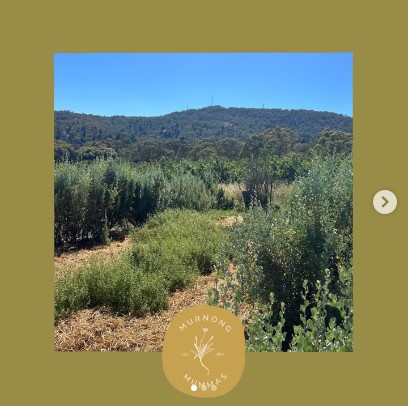
These days, we have the fabulous Murnong Mummas bushfood patch right here on the farm.
The Mummas is a First Nations-led organisation run by Ira Barker and is deeply involved in the native foods and botanicals sector. It’s a social enterprise that supports local First Nations people to further their skills by connecting with and sharing culture.
We feel incredibly privileged to be sharing land with and learning constantly from @irathemaker, who is responsible for the patch.
Bushfoods have always felt like a huge gap in our education.
Deciduous fruit trees (like apples, plums, cherries, etc.) are wonderful, and we love them. But they weren’t bred in this country, and they sometimes struggle to adapt to the harsh Australian climate.
We would never suggest having a garden without a fruit tree. But it seems sensible to also learn about the many amazing bush food plants that have evolved in this country, and maybe include some in your garden alongside the newcomers.
Bush food field trip
Years before the Murnong Mummas started on our place, we started our bush food education with a visit to Peppermint Ridge bushfoods farm in Tynong North.
The farm is on the boundary of lands owned by the Boonwurrung and Wurundjeri people.
Julie Weatherhead and her husband, Anthony Hooper, started their first native food polyculture experimental garden on their property in 1997.
They have many years of experience in growing bushfoods. Importantly, they also acknowledge the indigenous expertise they’ve accessed to develop their commercial enterprise.
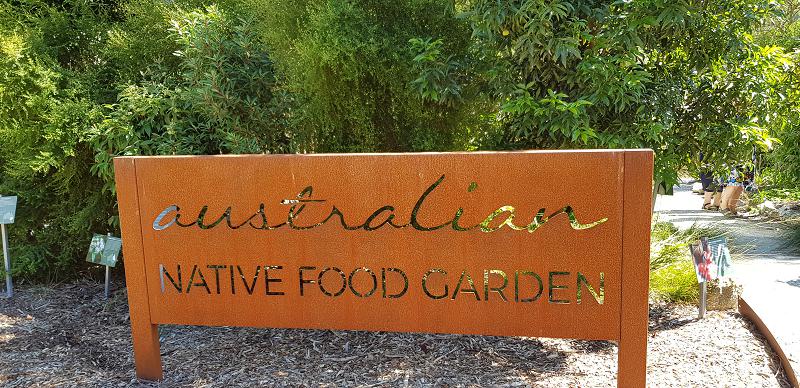
Seeing bushfoods in a garden setting
We took the tour of their native food garden and enjoyed an amazing lunch. It was one of the highlights of our trip.
Anthony gave us a very knowledgeable tour of their established gardens. Since starting the farm, Anthony and Julie have trialed over 60 species.
The gardens now feature many of the species that have proved to be the hardiest and most useful for home gardens.
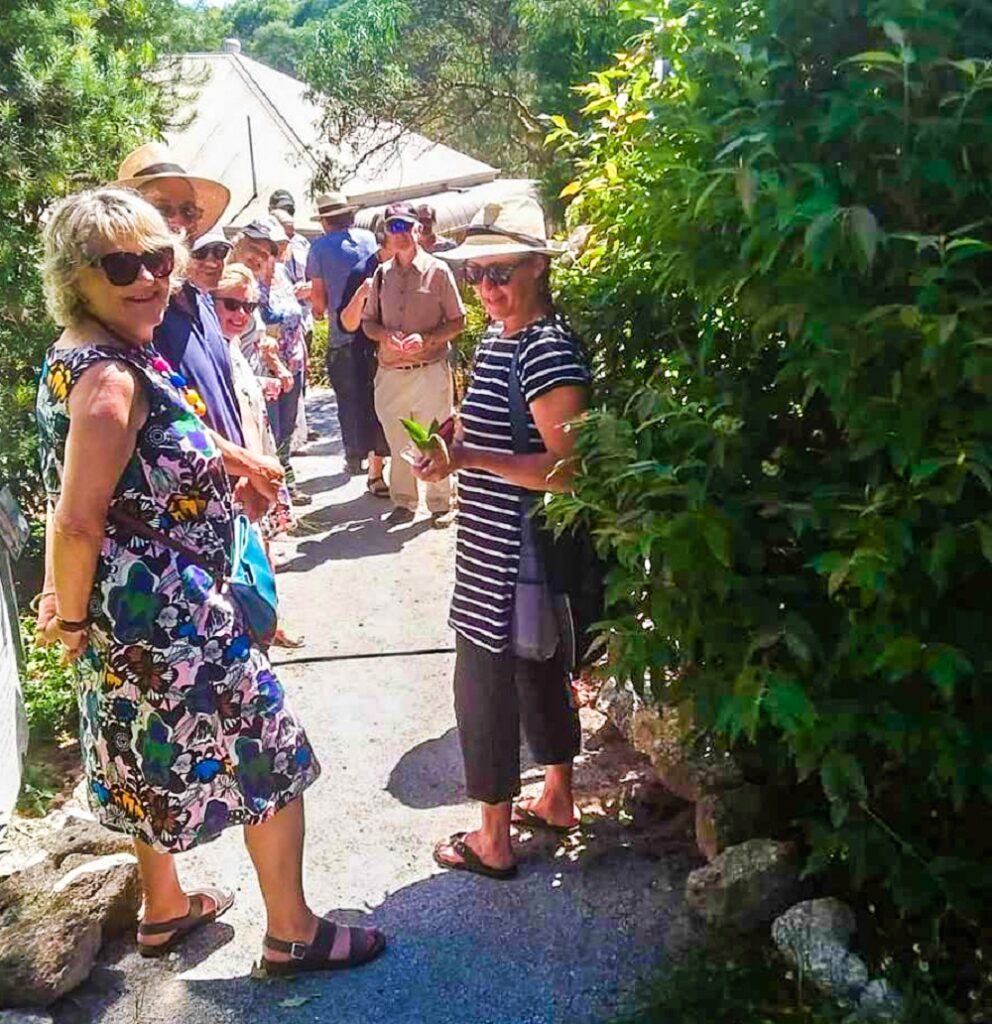
Anthony and Julie are very protective of their garden. We were asked not to sample any fruit or touch the plants unnecessarily as we were walking around.
Several of the plants are quite sensitive, and the fruits are likely to drop if they’re handled on the tree.
As fruit growers, we could appreciate the request. However, the plants were all very tempting, so it took all our willpower to resist!
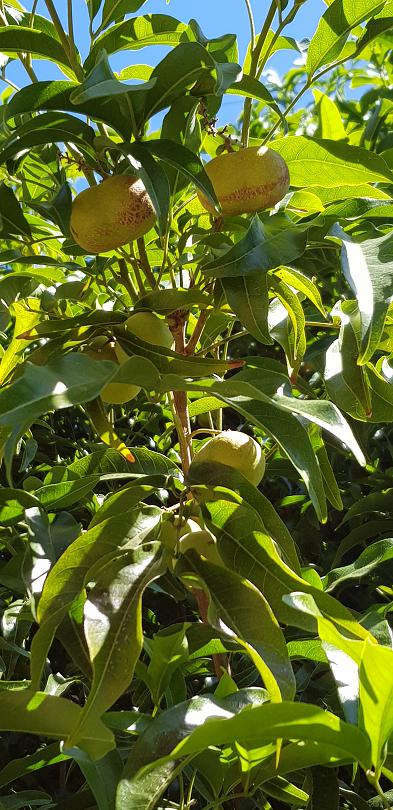
Eating bush foods
We were supplied with plenty of leaves to smell (and taste) as we went. We also got to taste some delicious tea as we were taking our tour. The tea was brewed in the garden from fresh Anise Myrtle and Lemon Myrtle leaves.
After the tour, we moved into the rustic farm cafe. It was the original Nar Nar Goon North Primary School building, dating back to 1929. In 1997, the family relocated the building to the farm to be used as an educational space and cafe.
It was officially opened in October of that year. The launch included a program featuring Aboriginal elders providing workshops on Aboriginal culture with traditional dancing and singing.
Anthony and Julie’s farm offers educational visits for school groups to learn about Aboriginal culture from First Nations educators.
However, it’s important to note that the farm is not Indigenous-owned or managed.
Choosing to buy from First Nations-led Bushfood enterprises
To redress that imbalance, we’d love to encourage you to seek out and explore food businesses and nurseries that are led by First Nations people. It’s one of the simple ways you can support the native food system in a way that’s of benefit to First Peoples.
There are many available — here are a few of our favourites, but a simple online search will help you find businesses close to you.
- Native Foodways – Culturally rich native foods that heal country and nourish community
- Murnong Mummas – An Indigenous-led social enterprise involved in the native foods and botanicals sector
- The Dreaming Food Group – A for-purpose company established to provide sustainable revenue to help Close the Gap
- Supply Nation – A database of verified Indigenous businesses
- Djambana Catering – An Aboriginal-led social enterprise offering high-quality Indigenous-inspired food
- Karkalla on Country – Bridging the gap between the booming ‘bush food’ industry and its traditional owners
- My Dilly Bag – Sustainably wild-harvested native herbs, spices, teas, relishes, and bushfoods
- Indigiearth – An Award-winning, Aboriginal-owned and established business
- Grow Locals – First Nations-led native nursery in Victoria
But back to the food
What a lunch!
We were too busy enjoying eating the food to take photos of it (sorry, very un-foodstagrammer of us)!
We did get a couple of shots of the menu to share with you, though, because it was such an interesting use of bush foods.
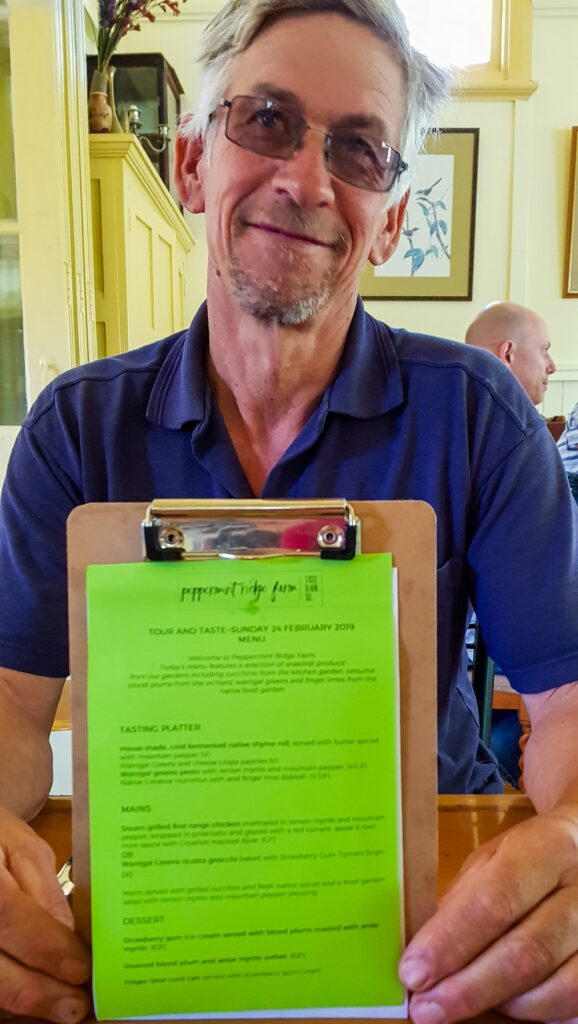
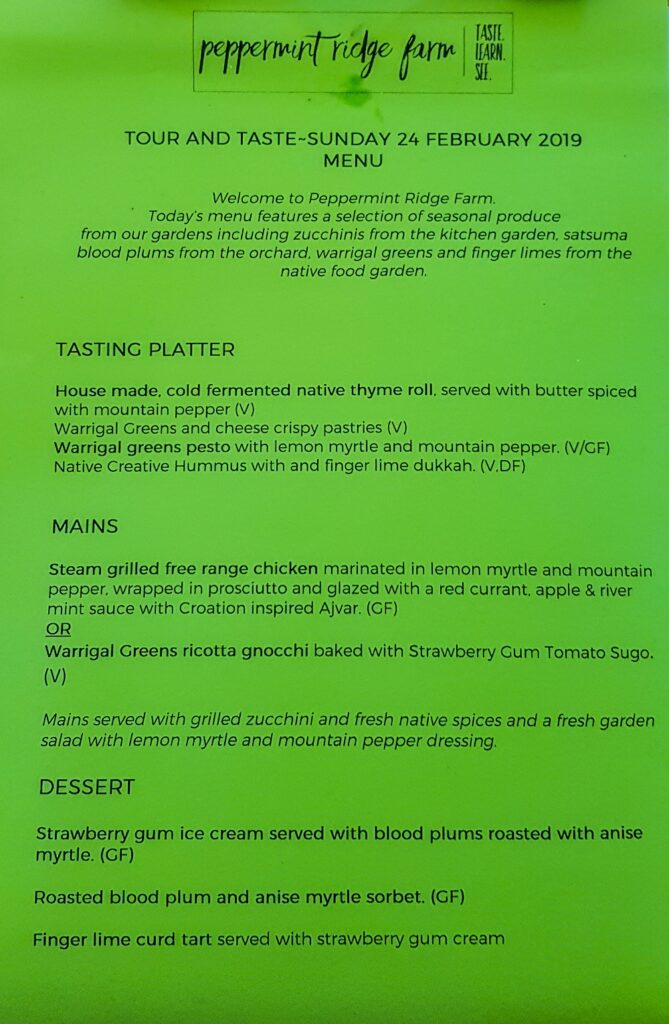
Warrigal greens pesto was unusually delicious, as was mountain pepper-spiced butter. The finger lime curd tart with strawberry gum cream was mouthwateringly good.
In fact, most of the dishes were a revelation, and all were beautifully prepared.
Acknowledging First Nations’ expertise
We were asked not to take photos of the information boards they’ve created for each of the native plants.
On reflection, we acknowledge some complexities around non-First Nations farmers protecting their intellectual property rights for bushfoods, considering the significant contributions of First Nations knowledge to this field.
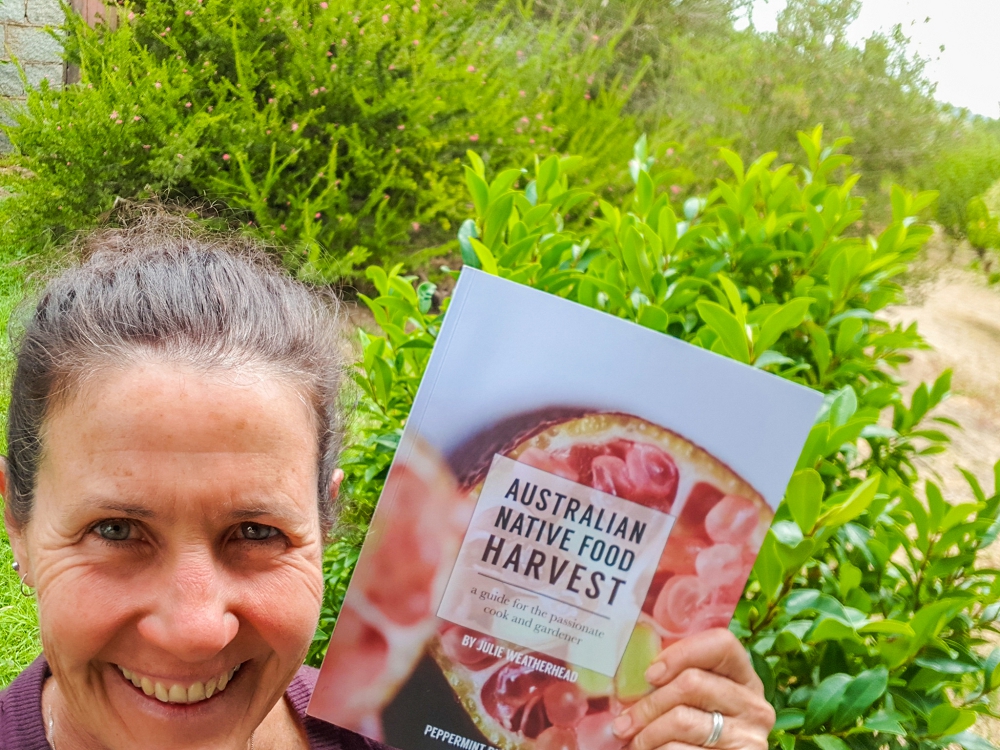
However, the long stewardship of the land by Aboriginal people and their amazing knowledge of the food and medicinal uses of bush food plants is acknowledged in Julie’s beautiful book, Australian Native Food Harvest.
It also recognises the huge loss of knowledge, culture, and skills as a result of colonisation.
“The pace, impact and scale of the occupation of Aboriginal lands meant the end of this way of life along with the sustainable agricultural systems that had been perfected over many years. Much of the last century has involved a long, slow and painful process of Aboriginal people reclaiming and reasserting their right to the land. Only recently has there been a push to provide due acknowledgement of the skills perfected by Aboriginal people on how to sustainably manage Australia’s native cornucopia.”
Julie Weatherhead, Australian Native Food Harvest: a guide for the passionate cook and gardener
Julie wrote the book in 1996 as the culmination of 20 years of experience growing and cooking native foods.
It gives detailed information about the 20 best native plants for growing in home gardens. It covers plants best suited to subtropical, temperate, and cool climates, as well as interesting sections on garden designs.
Bushfoods in your kitchen
There’s also a whole section in Julie’s book devoted to delicious-sounding recipes. Some were for plants that we already grow, such as Warrigal greens, native thyme, and finger lime.
Others we plan to include in the garden, like lemon myrtle and yam daisy.
Peppermint Ridge grows quite a few native food plants that we’d assumed would only grow in tropical climates.
We’re delighted that the Murnong Mummas patch now includes trees like mountain pepper, anise myrtle, and muntries, and we are loving learning more about these incredible bushfoods.
You may be surprised to learn how incredibly healthy some of these native foods are.
Did you know that mountain pepper leaves have 12 times more calcium than blueberries? They also have 9.3 times more antioxidants, 4.7 times more vitamin E, and 10 times more vitamin A.
Many native foods share these same characteristics. They have much higher levels of antioxidants, vitamins, and minerals than many of the “super foods” that have been popularised.
Yet to a large degree, they’re still ignored in most Western diets!
Bringing home new ideas
Field trips are full of surprises and never disappoint. We’ve never failed to bring home at least one new idea for our own farm.
It might seem a bit strange, but one of the things we were impressed by was the public toilet.
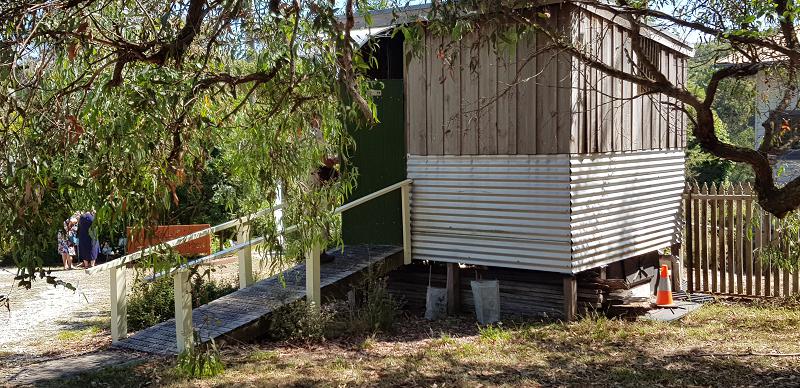
It was a composting toilet of clever design and execution. Beautifully clean, easy to access for people of all abilities, not at all smelly, and spacious enough inside for two toilets and a separate urinal!
It was impressive to see how well it can be done.
It definitely served as inspiration for the composting toilet we built at our place when we set up the Harcourt Organic Farming Co-op.
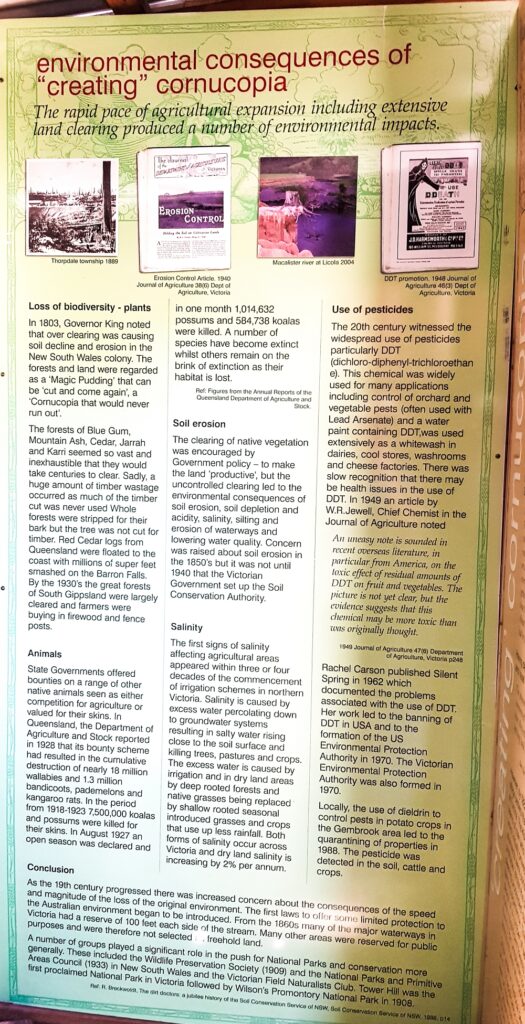
We particularly loved how Julie and Anthony used the space inside the bathroom to tell the story of the land. The descriptions of how farming has taken a huge toll on the environment are a great way of educating the public by stealth!
Embracing bush foods in your garden
We came away feeling more inspired than ever to encourage and welcome more native food plants in the ever-expanding biodiversity of our farm and our own kitchen garden.
They deserve to be grown, appreciated, and used. We’re also keen to include more of them in our diet.
The week after we visited, a massive bushfire in Gippsland threatened the property, burning right up to the fence. We were relieved to hear that Julie, Anthony, their family, and their farm survived the ordeal.
Many others and much of the beautiful remnant Gippsland bush weren’t so lucky. Our thoughts go out to everyone who’s been affected by the ever-present reality of bushfires.
Related Articles
Five ways to lead a more organic lifestyle
Five simple tips to help you live a more organic lifestyle and improve your health without breaking the bank.
Where to get fruit trees (and how nurseries work)
Our goal is to send our organic fruit trees to good homes (and gardens) far and wide. There’s always room for one more fruit tree, right?
Grafting citrus – ouch!
Grafting citrus is a great way to change varieties or create a new tree, as long as you can avoid those potentially painful prickles.
Katie and Hugh, I am soooo delighted that you finally got to Peppermint Ridge.
A bit of history : My children were brought up on Tynong Park, a 1000 acre farm at the corner of Tynong North Road and the Princes Highway. I left there in 1979.
We knew Julie’s father Max who ran the Corncupia Museum. Julie was a littld girl then and does not remember me.
I wrote to Julie years ago and suggested to her that I wanted to see Permaculture use more Indigenous plants instead of the myriad of exotics Permaculture recommends.
Also I have made lots of Warrigal Greens pesto at Yeats St.
As you know I am madly keen on Indigenous food plants and my dearest wish is to see something like Peppermint Ridge as another HOFC enterprise on MAFG.
Can you think of anyone who can do it? Or a group of women. What about Ingrid, Dayna, Carla, along with some really young keen beginners, students of horticulture, permaculture etc?
Hi Grace – it’s lovely to hear that the connection to bushfoods is so personal for you, and yes, we’re also very keen to have someone start an indigenous food enterprise as part of our co-op! We’re keeping our eyes peeled for someone that could take this exciting enterprise on.
Thanks for the great review. Let us know if we can assist in the future.
Thanks Julie – glad you saw this! We had a wonderful time at your place, and would love to come back.